By now, almost every company is asking how much AI will save them. And we get it: saving seems like a good option in a world that’s constantly in flux, and you never know what’s going to crack tomorrow. But in the grand scheme of things, AI-generated efficiency is about to become just table stakes in many industries: it’s the entry fee for remaining in the competition, but it doesn’t make you competitive.
.png?width=1200&height=628&name=Untitled%20design%20(48).png) Most efficiency gains will eventually, depending on your industry, end up redistributed to your customers, neutralised by your competitors, or, if you’re unlucky, actively accelerate the collapse of your own business model. So it pays off — quite literally — to reap the benefits while you still can.
Most efficiency gains will eventually, depending on your industry, end up redistributed to your customers, neutralised by your competitors, or, if you’re unlucky, actively accelerate the collapse of your own business model. So it pays off — quite literally — to reap the benefits while you still can.
The right question most leaders should be asking is what's the lasting value of the efficiencies. So you’ve saved money, resources, or effort with AI-driven efficiencies: then what?
Not all efficiency gains are created equal
We work on these sorts of questions with clients from multiple industries and compared a few of them to see how the AI efficiency effects cascade in different situations. Three usual patterns emerge.
In some cases, the AI-driven efficiency benefits mainly increase capacity and flow outward. In others, it reduces cost, but the savings need to be invested elsewhere to create any lasting new value. And in a third group, some of the efficiency efforts can directly enable building better services, products, or customer experiences on top of the efficiency improvement.
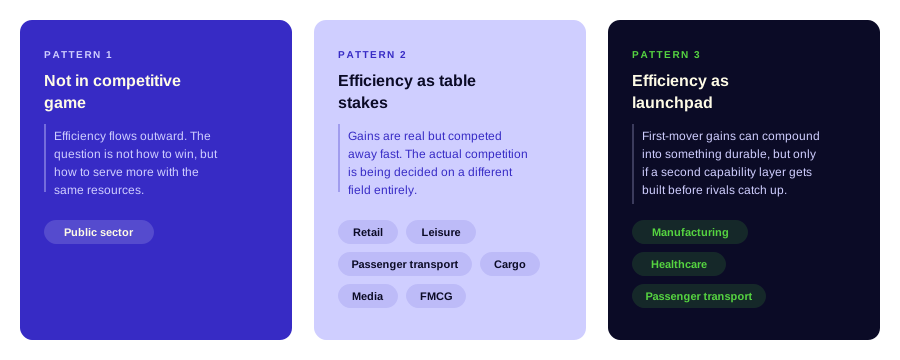
The pattern you're in shapes how AI creates value for you today, but also how long that value remains.
Durable goods manufacturing, for example, is where AI-driven efficiency can turn into something more. If you use AI to improve predictive maintenance, production planning, or quality control, you’re likely to cut costs while also generating data on how products behave, fail, and perform. That can be fed directly back into product and new feature design. The efficiency gains can thus end up changing the product itself.
The fast-moving consumer goods industry, for example, doesn’t work like that. You can use AI to improve forecasting, optimise promotions, and run a tighter supply chain, but that doesn’t improve your product or customer experience in any meaningful way. A shampoo or a chocolate bar doesn’t become more desirable because you planned or produced it more efficiently.
And then there are the industries where the efficiencies may end up eroding competitiveness. In the media sector, for example, AI makes content cheaper to produce, but also makes it easier to flood the market with low-cost bulk content. You can end up cutting costs and weakening your own position at the same time if you’re not careful.
Same idea of AI-generated efficiencies. Completely different outcomes.
How this plays out in different industries
The differences become much clearer when you look at multiple industries side by side. We looked at nine industries, using the same lens and a unified framework to understand how the AI-driven efficiencies behave across different contexts.
In our overview "The value of AI-driven efficiency across industries" addition to durable goods manufacturing, FMCG, and media, we've also looked at private healthcare services, passenger transportation, cargo, leisure & hospitality, retail, and the public sector. We've reviewed where their efficiency gains show up, who benefits from them, how quickly they disappear, and whether they change anything in terms of demand.
It gives you a more concrete view of how these patterns actually play out, and where your own situation might fit in.
Understanding which pattern you are in is the easy part. The challenge is making the right decisions that follow: what to invest in, where to accelerate, and what to stop doing. If you are still figuring it out, give us a call: we’re always happy to spar!

.png?width=406&height=228&name=cxo%20breakfast%20club_2026_1200x628%20(1).png)