
“When priorities shift in a project, clarity becomes the most important thing you can give a team.”
Engineering organisations today work in environments where systems are increasingly software driven and connected to larger ecosystems. Development often spans hardware, software and integration layers across multiple teams.
In these conditions, technical capability alone is not enough. Just as important is the ability to maintain clarity and alignment as priorities evolve.
.png?width=1200&height=627&name=Connectivity%20%20(8).png)
While working with the projects, a clear pattern appeared across different areas. The moments that slow progress are rarely caused by the technology itself, but by uncertainty around priorities, ownership or the overall objective of the system.
Across different projects, four elements repeatedly determine whether teams maintain momentum:
clarity of direction, alignment between stakeholders, the ability to use different perspectives within the team, and an environment where communication allows issues to surface early.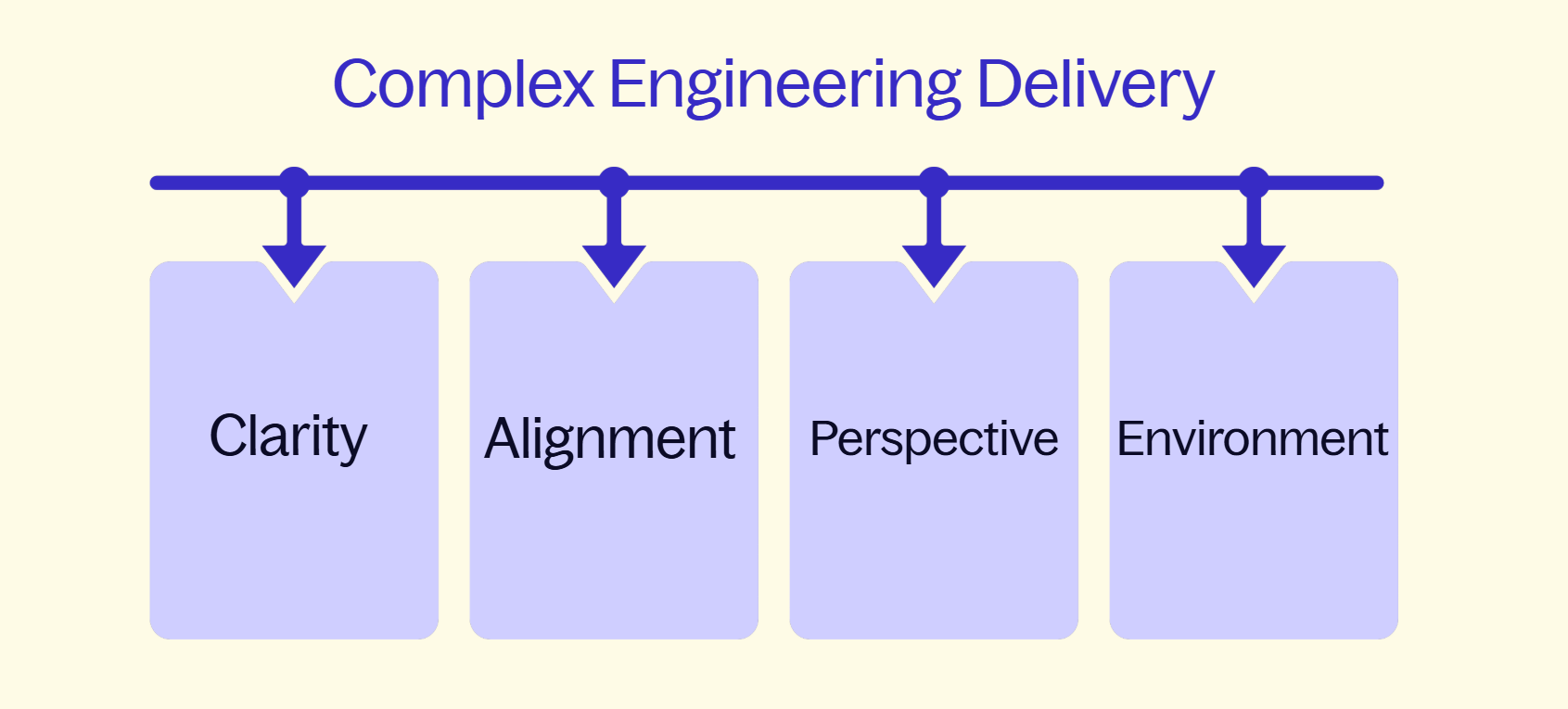
The sections below illustrate how these elements appear in practice.
Clarity: Maintaining Direction in Complex Environments
Modern engineering projects rarely follow a perfectly stable path. Technical dependencies emerge as development progresses, requirements evolve, and decisions made in one part of the system often influence several others.
In these situations, clarity becomes one of the most important leadership tools. Teams need to understand how their work contributes to the broader objective of the system and how decisions affect the wider architecture. When that understanding is present, teams can adapt to change without losing direction. When it is missing, uncertainty spreads quickly and progress slows.
Creating clarity therefore becomes less about controlling every step of the plan and more about ensuring that teams maintain a shared understanding of the objective as the project evolves.
Alignment: When Shared Understanding Restores Momentum
Clarity must be accompanied by alignment across the people involved in the project. As systems grow more interconnected and more stakeholders become involved, maintaining a shared interpretation of priorities becomes essential.
When alignment weakens, even technically strong teams can lose momentum. Engineers may work toward different interpretations of the goal, discussions become fragmented and decision making slows. Restoring alignment often requires stepping back from individual tasks and revisiting the broader objective of the system. Once that shared understanding returns, teams are able to move forward with greater confidence and coordination.
Case in Spotlight: Restoring Direction When Complexity Starts to Grow
Situations like this are not unusual in engineering projects where multiple dependencies evolve simultaneously. One engagement illustrates how quickly a team can lose direction when technical and organisational complexity increase at the same time.
During the delivery, both the client’s expectations and the technical prerequisites for the system began to shift. As the architecture developed and new dependencies became visible, the scope expanded and uncertainty grew around what should be prioritised next. The team had the expertise required to solve the engineering challenges, yet progress slowed because the broader objective of the work had become less clear.
Instead of pushing execution harder, the team paused to restore alignment. Stakeholders came together to revisit the purpose of the system and examine how the new requirements affected that purpose. By reframing the discussion around outcomes rather than individual features, the team was able to reorganise the scope and clarify the direction of the project.
.png?width=1200&height=627&name=Connectivity%20%20(6).png) The effect was immediate. Once the priorities were clearly understood and the reasoning behind them was shared across the team, discussions became more focused and decision making accelerated. What had previously felt uncertain gradually turned into a clearer path forward.
The effect was immediate. Once the priorities were clearly understood and the reasoning behind them was shared across the team, discussions became more focused and decision making accelerated. What had previously felt uncertain gradually turned into a clearer path forward.
Perspectives: Turning Different Ways of Thinking into Better Decisions
Engineering teams bring together people who approach problems differently. Some prefer careful analysis before acting, while others are comfortable moving forward through experimentation and iteration.
These differences can either strengthen decisions or create friction within the team. When discussions are dominated by a few voices, valuable insights may remain unheard. When too many viewpoints compete without structure, decision making can slow.
Creating space for different perspectives allows teams to benefit from a wider range of expertise. Structured discussions and clear communication help ensure that ideas are shared openly and evaluated constructively. When teams feel comfortable contributing their perspective and raising concerns early, the quality of decisions improves.
Environment: Creating the Conditions for Sustainable Collaboration
The final element shaping complex projects is the environment in which teams operate. Systems are increasingly interconnected, which means decisions made in one area often influence several others. In such environments, open communication becomes critical.
Projects that perform well typically share several characteristics. Direction is clearly understood, ownership is visible and communication allows concerns to surface early rather than late in the development process. When teams operate in an environment where questions can be raised openly and assumptions can be challenged constructively, issues are addressed earlier and collaboration becomes stronger.
.png?width=1200&height=627&name=Connectivity%20%20(7).png) As engineering systems continue to grow in complexity, leadership increasingly revolves around creating the conditions where teams can stay aligned, maintain clarity and collaborate effectively even as projects evolve. That means helping teams focus on the shared objective of the system and creating the environment where the right discussions can happen early.
As engineering systems continue to grow in complexity, leadership increasingly revolves around creating the conditions where teams can stay aligned, maintain clarity and collaborate effectively even as projects evolve. That means helping teams focus on the shared objective of the system and creating the environment where the right discussions can happen early.


.png?width=406&height=228&name=Connectivity%20%20(12).png)